

How to write a corrective action notice that gets fixed.
A good corrective action notice names one hazard, shows it in a marked photo, describes the observed condition in plain words, states the corrective action and due date, cites the standard it relates to, and leaves room for the recipient’s response and after-photo.
One notice, one hazard
Put each hazard in its own notice, even when several share a photo or a subcontractor. One hazard per record means one owner, one due date and one clear answer. When you have several for the same company, send them together in one file rather than merging them into one item.
The eight parts of a clear notice
| Part | What good looks like |
|---|---|
| Project and location | Project name, level, grid line or area. “L6, east slab edge, grid 4–7.” |
| Marked photo | The original photo with the concern circled, so nobody has to guess what you meant. |
| Observed condition | What you saw, not a conclusion. “Worker within 6 ft of an open slab edge; no guardrail, net or tie-off visible.” |
| Priority | High, medium or low, with one line of reason. |
| Reference | The provision it relates to, such as 29 CFR 1926.501(b)(1), with the official text or a link to it. |
| Corrective action | What must change, specific enough to act on. “Install guardrail system along the east edge before work resumes.” |
| Due date and recipient | A named company and contact, and a date for the response. |
| Response section | Status, what was done, and an after-photo, filled in by the recipient. |
An example
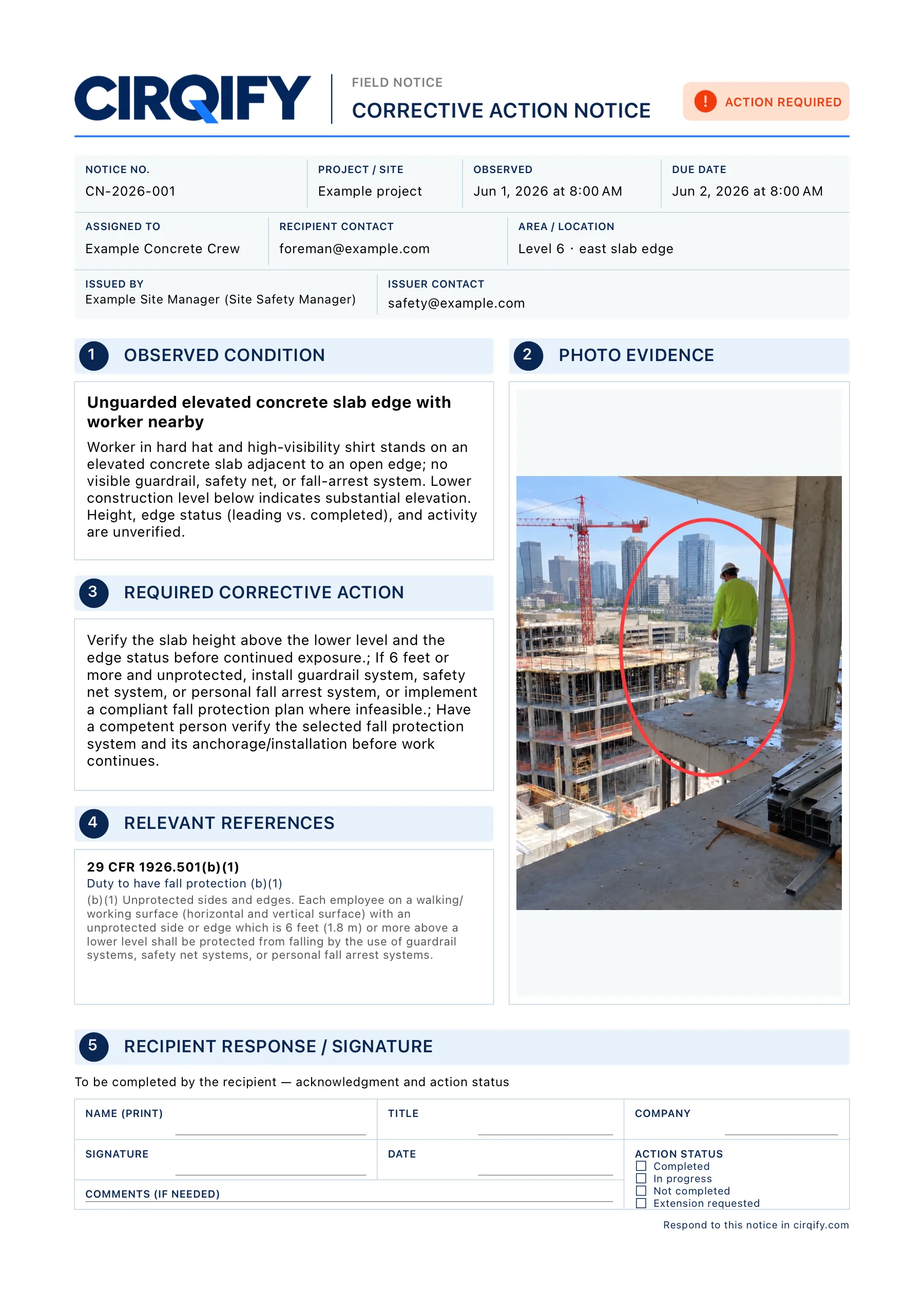
Write what you saw, then verify what you couldn’t
Photos leave out facts that decide whether a standard applies: the height of a drop, the depth of a trench, whether a guardrail was removed for a task a minute ago. Describe the visible condition, list what still needs checking, and confirm it on site. It keeps the notice accurate and the conversation with the subcontractor about the fix, not the wording.
Common mistakes
- Vague locations like “on the third floor” with no area or grid.
- A photo with no mark, so the recipient fixes the wrong thing.
- “Fix fall protection” instead of a specific action.
- No due date, so no one knows when to follow up.
- Calling the notice an OSHA citation. It’s an internal corrective action record.
- Closing the issue on a reply alone, without an after-photo or a walk-back.
Doing it in Cirqify
Circle the hazard in your photo and we draft the observed condition, priority, reference, corrective action and on-site checks. Add the recipient and due date, review, and send the PDF with a pre-written email or text message. When the reply comes back, import it and the response lands on the issue’s timeline. See how tracking works.